 Trend in eighth-grade NAEP reading achievement-level results, 1992–2024. Source: NAEP, The Nation’s Report Card.
 Trend in eighth-grade NAEP reading achievement-level results, 1992–2024. Source: NAEP, The Nation’s Report Card.
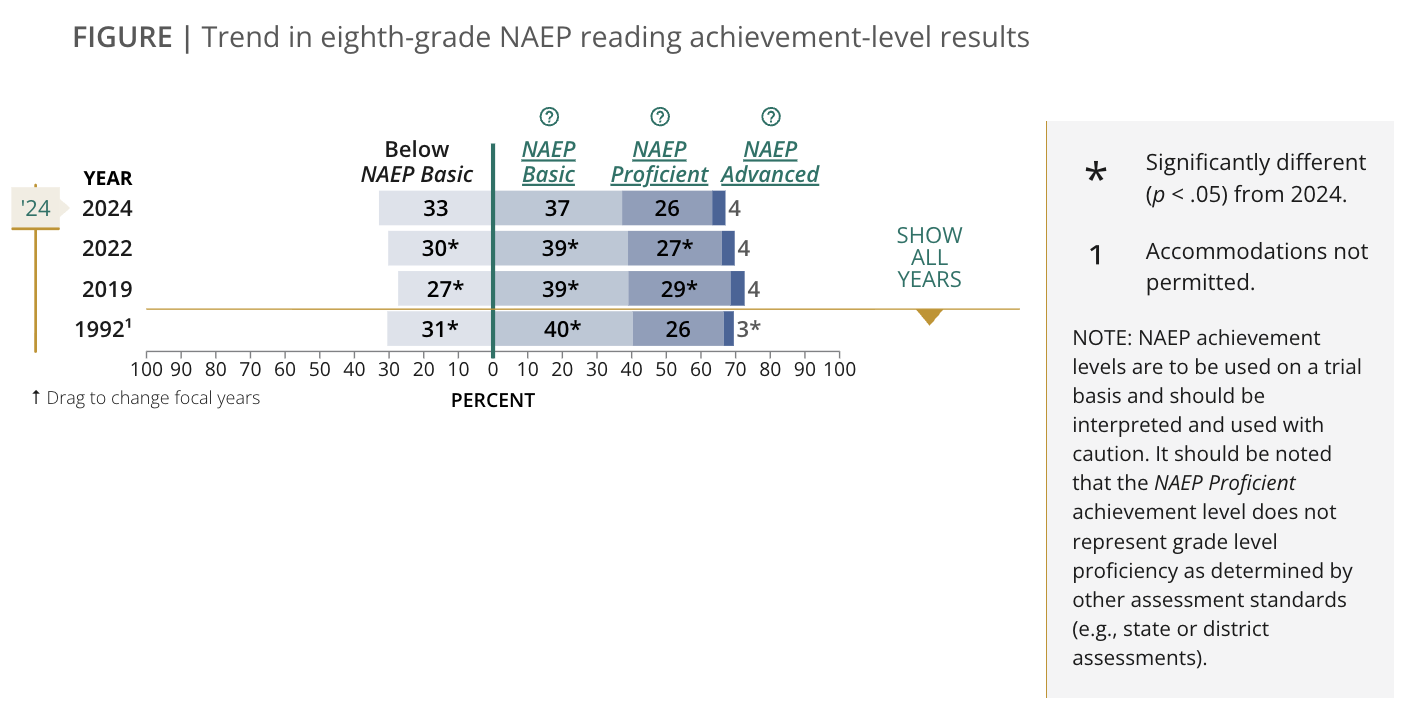
To be clear, these are two entirely different groups of students tested four years apart. The eighth graders aren't those struggling fourth graders grown up. But honestly, that’s exactly why this matters. It means whatever is happening in fourth-grade classrooms is also happening in eighth-grade classrooms, at the same rate.
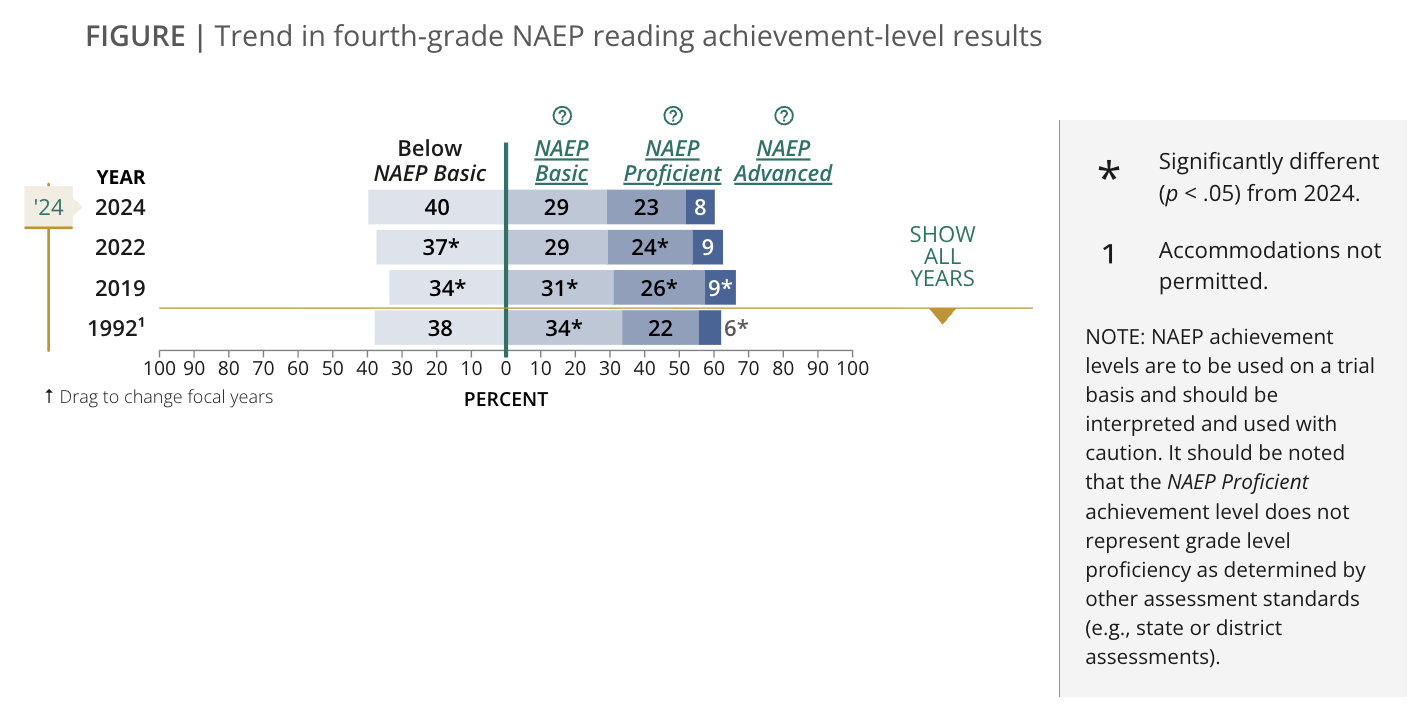
Here is a crucial detail the headlines completely skip: NAEP’s version of “proficient” is way tougher than you think. It's probably higher than your own state's actual grade-level standard. While state tests usually use "proficient" to mean a student is meeting grade-level expectations, NAEP wants a student who can critique and analyze a challenging text.³ That means more than 30% of fourth graders are likely fine by their state’s benchmarks.
What actually concerns reading researchers is that forty percent of fourth graders scored below NAEP’s Basic level in 2024.⁴ That means nearly half the class is missing the absolute bare minimum. A student in this range typically can’t explain why a character in a story did something, even when the story says so directly. A little extra homework isn't going to fix this. The core foundation is missing.
None of this is new. Reading scores have hovered here for decades. The 2024 fourth-grade figure isn’t statistically different from 1992.⁵ What is new, though, is how bad things are getting at the very bottom. Between 2022 and 2024, performance dropped across the board—unless you were in the highest 90th percentile. The students already struggling are losing the most ground.
So what’s going on?
There is a crucial piece of the puzzle that parents almost never get told. Most state-approved literacy curricula only include daily time for teaching foundational skills — sounding out words, spelling, word recognition — through second grade. But the reality is that starting in third grade, most curriculums don't include a phonics component. That’s because those foundational skills were already taught in kindergarten through second grade. At best, foundational skills practice shrinks to a five-minute routine at the end of a lesson. At worst, it falls completely on the teacher to figure out how to help the students who are struggling in reading. Schools can purchase a supplemental phonics curriculum, but to fit it into the schedule, something else has to get cut — like science or social studies. By third grade, there isn’t time to teach your child how to read anymore. According to most states’ standards, they’re expected to already know.That’s exactly why you have to trust your gut right now. Playing the “wait and see” game comes with a massive cost. Parents of struggling first and second graders are often told by well-meaning friends to give it time—that reading will eventually “click.” But while you're waiting, something else is quietly taking root at home. It’s the sudden stomachaches right before reading time. The quiet whispers of “I’m just stupid.” The book that gets shoved off the table. That isn't an attitude problem. Researchers describe a self-reinforcing cycle: repeated failure affects a child’s identity as a reader, which produces anxiety, which leads to avoiding books altogether. Less practice means a wider gap.⁶ Large longitudinal studies suggest the anxiety follows the reading struggle rather than causing it, then makes it worse.⁷ I don’t have to explain this cycle to you. I know you’re watching your child live it every day.
If you’re concerned about your child’s reading, what can you do?
First, take a breath. If your kid's score is lower than you hoped, this is absolutely not a failure on your part—or theirs. Half of teacher preparation programs spend fewer than two instructional hours teaching future teachers how to support struggling readers, and 72% give them no chance to practice it.⁸ That’s true even of programs rated highly on everything else. Your child’s teacher wants to help, but they most likely were never taught how.The good news in all of this is that it doesn't have to be this way. Reading researchers estimate that more than 90% of all students could learn to read with evidence-based instruction.9 Think about that: fewer than one in ten students should actually be struggling. Yet right now, four in ten need the basics. Let’s be very clear: that gap isn’t because our students can’t learn. It's because they need effective instruction by trained professionals.
Second, turn the report into an actual conversation. A score on a report is just a summary, not an explanation. The real answers you need are usually just one good question away. Try bringing these specific questions to your child’s teacher:
- “Can we look at the Skills Report together?” Almost every assessment generates one of these. It might be called something else, but it breaks that overall score down into specific skills. Schools rarely send this part home, but teachers can usually print it out if you ask.
- "Does my child need support in decoding or comprehension?” This is an important distinction. Whether your child is having a hard time sounding out words versus understanding what those words mean requires different approaches.
- “Is there a specific time in the school day for them to get this extra help?” Make sure to ask if this time covers skills from earlier grades, too. Often, this is exactly what a struggling reader needs most.
- “What can I do at home to reinforce these skills?” Ask for targeted activities rather than just general reading time. You want to focus on the specific concepts your child needs right now.
This is the first post in a series for parents of struggling readers — what the data actually says, why schools are structured the way they are, and what actually helps.
Endnotes
- Roughly 3.7–3.9 million U.S. students are enrolled in fourth grade each year (NCES). At 40% scoring below NAEP Basic, that’s an estimated 1.5 million fourth graders nationally. nces.ed.gov
- The Nation’s Report Card, 2024 NAEP Reading Assessment. Figures cited are for public school students. NAEP does not test every student — it assesses a nationally representative sample — and individual student scores are never reported. nationsreportcard.gov
- On the distinction between NAEP Proficient and state-defined grade-level proficiency, see Reading Universe, “What Do the NAEP Reading Scores Mean?” readinguniverse.org. NCES states directly that NAEP Proficient “does not represent grade level proficiency as determined by other assessment standards (e.g., state or district assessments),” and the National Assessment Governing Board’s 2018 policy statement clarifies the same point.
- NCES, National Trends and Student Skills, 2024 NAEP Reading. nationsreportcard.gov. Skill descriptions drawn from NAEP’s grade 4 achievement-level descriptions and Reading Universe’s summary of what below-Basic performance looks like.
- Same source as note 4. NCES reports the 2024 fourth-grade percentage at or above NAEP Proficient was not significantly different from 1992, and that 2024 scores were lower than 2022 at all selected percentiles except the 90th.
- Francis, D. A., Caruana, N., Hudson, J. L., & McArthur, G. M. (2019). “The association between poor reading and internalising problems: A systematic review and meta-analysis.” Clinical Psychology Review, 67, 45–60. doi.org/10.1016/j.cpr.2018.09.002. The first systematic review and meta-analysis on this question; found poor readers at moderate risk for internalising problems and at greater risk for anxiety than for depression. The fuller cycle described here — self-concept, avoidance, reduced practice — is a synthesis discussed in Polychroni et al. (2024), Frontiers in Education 9:1371627, and Boyes et al. (2019), Australian Psychologist 55, 62–72.
- McArthur, G., Badcock, N., Castles, A., & Robidoux, S. (2022). “Tracking the relations between children’s reading and emotional health across time: Evidence from four large longitudinal studies.” Reading Research Quarterly, 57(2), 555–585. doi.org/10.1002/rrq.426. Structural equation modeling across four longitudinal databases (UK, US ×2, Australia; combined n ≈ 23,800) found emotional health at age 5 unrelated to reading at age 7, while reading at 7 was related to emotional health at 9 and 11. The authors present this as a working hypothesis that poor reading influences emotional health rather than the reverse, and note the underlying mechanisms remain unknown.
- Ellis, C., Noble, R., Drake, G., & Peske, H. (2026). Teacher Prep Review: Decoding Progress in Reading Preparation, p. 12. National Council on Teacher Quality. nctq.org. Based on analysis of course materials from 721 elementary teacher preparation programs across all 50 states and D.C. NCTQ conducts both research and advocacy.
- Same source as note 8, citing Torgesen, J. K. (2004), “Preventing early reading failure,” American Educator 28(3). NCTQ notes this estimate derives from analysis of word-reading skills rather than reading comprehension directly, though word reading is a necessary precursor to comprehension.